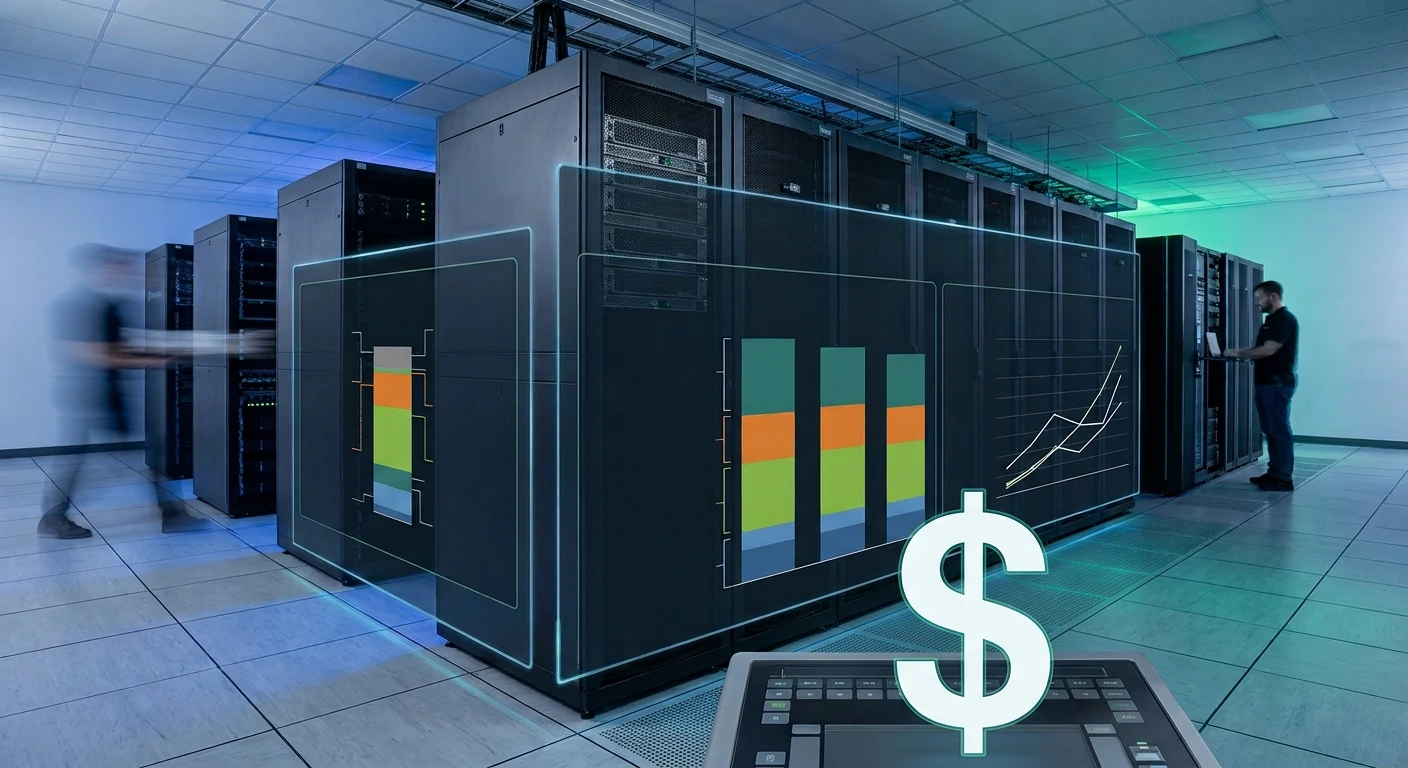
If you are researching the capital expenditure required to build or deploy high-performance compute infrastructure, the short answer is sobering: A standard enterprise AI server cluster (typically configured with 8x NVIDIA H100 or H200 GPUs) costs anywhere from $250,000 to over $400,000 fully integrated.
For smaller setups, a single-node enterprise workstation featuring an NVIDIA A100 or L40S ranges from $15,000 to $35,000.
When non-technical founders or enterprise buyers ask “how much does an enterprise ai server cost on average?”, they usually only look at the sticker price of the graphics cards. They forget that an AI server is a complex ecosystem requiring high-speed interconnects, massive power distribution units (PDUs), redundant enterprise power supplies, and specialized high-throughput networking.
This guide breaks down the true cost components of enterprise AI infrastructure in 2026, from the bill of materials (BoM) to hidden operational overheads.
💡 Quick Answer: A full 8-way enterprise AI training server (8x H100/H200 SXM) averages $300,000 to $380,000. Single-node inference servers (like 1x or 2x H100/L40S PCIe) range from $20,000 to $50,000.
1. Enterprise AI Server Pricing Tiers (The Breakdown)
Enterprise compute isn’t sold as a flat commodity; it scales according to model training demands and interconnect topologies. The table below outlines the current market pricing tiers for AI servers in 2026:
| Server Tier & Configuration | Typical Market Price Range | Primary Use Case |
|---|---|---|
| Entry-Level Inference Node (1x-2x L40S or RTX A6000) | $8,000 – $18,000 | Smaller local LLM serving, image rendering |
| Mid-Tier Inference & Tuning Node (1x-2x H100 / A100 PCIe) | $20,000 – $55,000 | Single-node QLoRA fine-tuning, high-context inference |
| Heavy Enterprise Training Cluster (8x A100 80GB SXM) | $150,000 – $220,000 | Legacy foundation model training, large dataset analytics |
| Flagship AI Training Supernode (8x H100 / H200 SXM5) | $300,000 – $400,000+ | Large Language Model pre-training, multi-node scaling |
As tracked on our live Market Rates Table, renting time on these machines ranges from $1.50 to $4.00+ per GPU-hour, reflecting the staggering capital required to deploy them.
2. Hardware Component Cost Analysis (Where Does the Money Go?)
Why does an 8-way H100 server cost as much as a luxury residential house? Let’s dissect the bill of materials (BoM):
A. The Accelerators (50%–70% of total cost)
Eight NVIDIA H100 SXM5 GPUs alone account for the vast majority of the budget. Each H100 GPU costs between $25,000 and $35,000 depending on supply contracts. These cards maintain high secondary market valuations due to persistent global supply constraints and their unparalleled performance in FP8 and FP16 matrix multiplications.
B. Baseboard & NVSwitch Fabric (15%)
This is the most misunderstood component. Enterprise servers require specialized baseboards and NVSwitch interconnects. Why? Because when you train a Large Language Model across 8 GPUs, those GPUs must communicate constantly.
- A standard PCIe motherboard limits communication to about 64 GB/s per GPU.
- NVSwitch allows all 8 GPUs to communicate at ultra-high speeds (up to 900 GB/s bi-directional per GPU). Without this fabric, the GPUs would sit idle waiting for data from their peers, stalling the entire training process. This specialized baseboard alone can cost $20,000+.
C. Host CPUs, RAM, and Storage (10%)
An enterprise AI server cannot be bottlenecked by a cheap CPU. It requires dual enterprise-grade processors (such as AMD EPYC Genoa or Intel Xeon Sapphire Rapids), 1 TB to 2 TB of ECC DDR5 system RAM, and enterprise NVMe storage arrays (often 8TB to 30TB) configured in RAID for high-speed dataset loading.
D. Power Supplies and Chassis (5%)
Standard power supplies would melt under the load. These servers require redundant 3000W to 5000+ hot-swappable enterprise power supply units (PSUs). The chassis must also support high-airflow cooling for the dense GPU arrangement.
3. The Hidden Costs: Power, Colocation, and Cooling
Buying the server is only half the battle. Operating it introduces heavy overhead that is often overlooked in initial budgets:
A. Massive Power Draw
A fully loaded 8x H100 server pulls between 10 kW and 10.5 kW under peak load. To put that in perspective, a standard American household averages about 1.2 kW of continuous draw. Running this server 24/7 at an average commercial power rate of $0.10/kWh costs over $700 per month in electricity alone for just one machine. At European rates ($0.25/kWh), that same server costs $1,800/month in power.
B. Tier-3 Colocation Mandate
Standard office spaces cannot handle 10kW per rack safely without tripping facility breakers or causing a fire hazard. You must place enterprise servers in Tier-3 colocation facilities. These facilities provide:
- Redundant cooling (N+1).
- Uninterruptible Power Supplies (UPS) and backup generators.
- Physical security and biometric access.
- Multi-homed internet bandwidth.
Colocation providers bill heavily for rack space based on power density (kW per rack), not just physical space. A single 10kW rack can cost $2,000 to $4,000 per month in colocation fees.
For comparison against home-scale hardware power overhead, review our breakdown on the GPU Electricity Cost Ceiling Guide.
4. Renting vs. Buying: Why Most Companies Use Cloud Compute
Given the massive capital expenditure ($300k+ per node) and rapid depreciation cycles, most startups and mid-sized enterprises choose cloud compute rental over purchasing bare-metal infrastructure.
The Depreciation Trap
NVIDIA releases a new architecture roughly every two years (Hopper, then Blackwell, then Rubin). A $300,000 server purchased today will lose 50% of its market value the moment the next generation launches. The hardware doesn’t break; it just becomes economically obsolete.
Agility and Scaling
Renting instances via decentralized networks (like Vast.ai{:target=“_blank” rel=“sponsored nofollow noopener”}) allows teams to scale up from one GPU to fifty GPUs instantly without tying up millions in liquid capital. You pay only for the compute you use, bypassing the need for physical space, cooling, and maintenance staff. Compare Vast.ai and Clore.ai fees in our full platform comparison.
Maintenance Offloading
Hardware failures, thermal paste degradation, and PCIe lane faults become the host’s problem, not yours. When a GPU in a cloud cluster fails, the provider swaps it out. When your own $30,000 H100 fails, you are the one dealing with RMA (Return Merchandise Authorization) processes and downtime.
To calculate your own cost models for running compute nodes, test our interactive Hosting Calculator.
5. Frequently Asked Questions
How much does a single NVIDIA H100 server cost?
A single-node PCIe H100 server generally costs between $25,000 and $45,000, whereas a full 8-way enterprise SXM5 cluster ranges from $300,000 to $400,000+.
Why are enterprise AI servers so expensive?
The cost is driven primarily by the silicon manufacturing complexity of the GPUs, specialized high-speed interconnect fabrics (like NVSwitch), enterprise-grade ECC memory, and redundant power infrastructure. The cooling and power infrastructure alone can add 30% to the total cost of ownership.
Is it cheaper to rent or buy AI servers?
For nearly all companies except major hyperscalers, renting cloud compute is significantly cheaper and less risky due to rapid hardware obsolescence and high maintenance overhead. A $300k server becomes obsolete in 24 months, making renting a safer financial bet.
What is the difference between SXM and PCIe H100 GPUs?
SXM5 GPUs connect directly to a specialized baseboard via NVLink (up to 900 GB/s), enabling massive multi-GPU scaling for training. PCIe GPUs use the standard motherboard slot (up to 128 GB/s), making them cheaper but slower for multi-GPU communication.
6. Sources & Official Documentation
- NVIDIA H100 Tensor Core Architecture Datasheet — (checked October 2026)
- NVIDIA NVSwitch and NVLink Specifications — interconnect bandwidth and scaling (checked October 2026)
- Enterprise hardware supplier market pricing aggregators — (checked October 2026)
- Operational infrastructure metrics: GPUEARN Methodology Page
Written by Alex Rivers (Senior Hardware Infrastructure Analyst) and the GPUEARN Research Team. Building AI infrastructure requires balancing raw performance against total cost of ownership (TCO).
Last updated: October 25, 2026