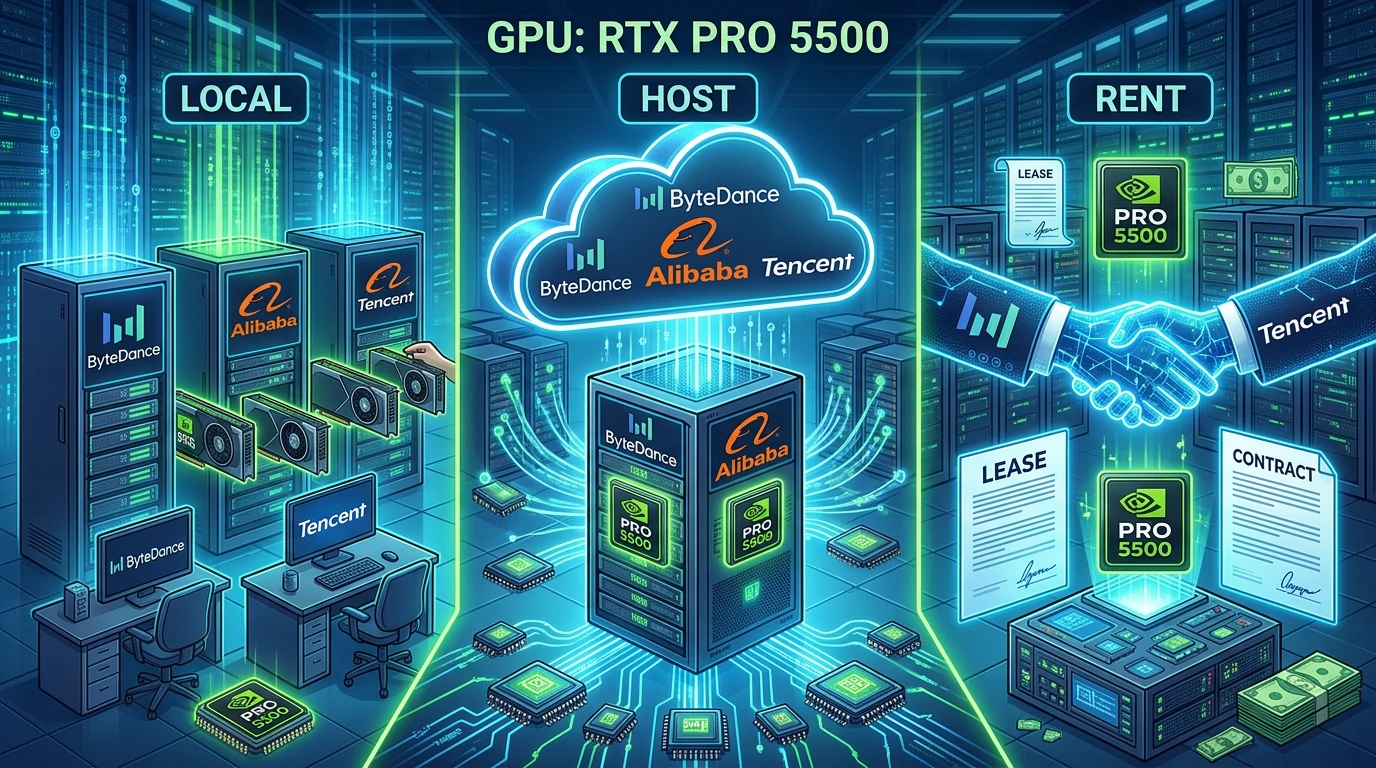
On October 20, 2026, Reuters reported — citing sources familiar with the matter — that ByteDance, Alibaba, and Tencent have placed orders for more than 3 million RTX PRO 5500 graphics cards at roughly $11,400 per card, pushing total sticker demand past $35 billion.
The striking part isn’t just the sheer volume. It’s the market response:
- Massive Deficit: Total Chinese demand has topped 6 million units, while NVIDIA reportedly cannot build more than ~3 million cards globally across all of 2027.
- Supply Constraints: NVIDIA told partners it cannot guarantee fulfillment, with industry sources warning buyers might receive only 5% to 10% of requested allocations. This is largely because TSMC capacity is preparing to pivot toward next-gen Rubin architectures, per reports summarized by TrendForce and Tom’s Hardware.
⚠️ Reality Check: Treat the $35 billion figure as demand at list price, not booked revenue. Reuters itself categorized it as a “collective sticker request.” Furthermore, receiving only 10% of the requested units means actual revenue booked by NVIDIA will be a fraction of this headline number.
If you rent out hardware on decentralized P2P networks, macro supply crunches like this directly impact your day-to-day operations. This guide breaks down what this means for your rig, your rental yields, and the future of GPU hosting.
1. Why the RTX PRO 5500, Specifically?
Under current U.S. export controls, high-end datacenter accelerators like NVIDIA’s Blackwell B300 are barred from Chinese markets entirely, and H200 exports require complex case-by-case licensing.
The RTX PRO 5500 — a 600W workstation card featuring 84GB of GDDR7 memory — sits comfortably below the compliance threshold. Chinese buyers want them primarily for AI inference: serving trained models for chatbot queries and real-time generation, where high memory throughput is paramount.
The Inference vs. Training Divide
This reveals a fundamental shift in the global AI economy. Training foundational models (like GPT-5 or Llama 4) requires massive compute and ultra-fast interconnects (like NVSwitch). But inference — actually running these models for end-users — is a different beast. It is overwhelmingly memory-bound.
For Alibaba or ByteDance to serve millions of users, they need to hold massive models in VRAM (memory) as close to the user as possible. An 84GB card with GDDR7 memory is the perfect tool for this, because it can hold large context windows without sending data back and forth over slower networks.
2. What This Means for GPU Hosts
If you rent out hardware on decentralized P2P networks like Vast.ai or Clore.ai, macro supply crunches like this directly impact your operations across three vectors:
A. The Inference Wave Lifts High-VRAM Rental Demand
Enterprise buyers chasing 84GB workstation cards signal a broader truth: AI inference workloads are overwhelmingly memory-bound. On decentralized peer-to-peer marketplaces, renters consistently pay premiums for large-VRAM nodes. As tracked in our Market Rates Table, high-end workstation variants (like the RTX A6000 or L40S) already command significant hourly rates compared to standard consumer silicon. When enterprise supply is rationed, this premium spills over into the P2P market.
B. Hardware Acquisition Costs and Payback Math
When compliance-limited workstation cards face massive scarcity, secondary and primary market prices for adjacent hardware (used RTX 4090s, 5090s, and high-VRAM nodes) tend to reprice upward. Why? Because buyers who cannot get the RTX PRO 5500 will look for the next best alternative: your 4090.
If hardware acquisition costs climb by 20% to 30%, your payback horizons stretch out. You can model how hardware price changes affect your timeline using our interactive Hosting Calculator. For a deeper look at the RTX 4090 economics, read our full profitability guide.
C. Consumer-Class Fab Competition
With TSMC’s fab allocation shifting to accommodate specialized enterprise and workstation orders, consumer chip availability (like the RTX 50-series) remains structurally constrained. Hosts planning around hardware availability should account for sustained component scarcity rather than a return to traditional retail pricing. This is especially important for enterprise-grade server deployments. The era of finding a cheap GPU at your local electronics store may be paused for the foreseeable future.
3. The Ripple Effect on the Secondary Market (Why Used GPUs Are About to Get Expensive)
When new enterprise hardware is unavailable, the market does not stand still. It cascades downward.
In a normal market, enterprise buyers would purchase new H100s or RTX PRO 5500s. When they cannot, they turn to the secondary market. They start buying up used RTX 4090s, 3090s, and even high-end workstation cards like the RTX A6000. This creates a domino effect:
- Enterprise Demand Spikes: Buyers who need inference capacity but can’t get the new cards start buying whatever is available on eBay or through brokers.
- Prices Surge: As supply of used cards dries up, prices on platforms like eBay and local marketplaces climb by 15% to 30%.
- Hosts Panic-Buy: Home hosts who see rental rates rising rush to buy hardware before it’s too late, driving prices even higher.
For someone who already owns a rig, this is great news. Your hardware becomes more valuable overnight. For someone looking to buy their first rig, the entry cost just went up significantly.
4. What to Watch Next
Keep a close eye on these three developments over the next two quarters:
- Q4 2026 – Q1 2027 Allocations: Monitoring how the 5% to 10% fulfillment rate affects global component pricing. If NVIDIA truly delivers only 300,000 cards out of 3 million, the secondary market will react violently.
- Workstation Rental Yields: Observing whether enterprise workstation rental rates climb on our live telemetry data. If enterprise buyers can’t build their own clusters, they will rent yours.
- Regulatory Shifts: Tracking how export policy revisions alter the compliance landscape for regional compute suppliers. A change in Washington could flood the market, or restrict it further.
The Bottom Line for Hosts: The AI gold rush is no longer just about training massive models. It’s about inference at scale. If you already own high-VRAM cards, you are in a stronger position than ever to command higher rental yields. But remember that power costs can erode these gains. Check our Electricity Cost Ceiling Guide to ensure your margins are safe. And if you are planning to buy new hardware, do it soon—before the secondary market reacts to this shortage.
5. Frequently Asked Questions
Why are Chinese tech giants buying RTX PRO 5500s instead of datacenter chips?
Strict U.S. export controls prohibit the sale of top-tier datacenter chips (like Blackwell B300) to China, forcing buyers to acquire export-compliant workstation cards like the RTX PRO 5500 for AI inference.
How does this affect individual GPU hosts?
When enterprise supply is rationed, broader demand spills into decentralized cloud rentals, potentially raising workstation rental rates while simultaneously increasing the upfront cost to acquire new hardware.
Will this order increase the price of used RTX 4090s?
Yes, likely. As enterprise buyers face massive shortages for workstation cards, demand for adjacent high-VRAM hardware (like the 4090) typically surges on secondary markets, driving up acquisition costs for hosts.
Where can I check current live rental rates for high-VRAM cards?
You can review live On-Demand median pricing across multiple networks on our Market Rates Table.
What is the RTX PRO 5500 used for?
It is primarily used for AI inference, serving trained models for chatbot queries and real-time generation. Its 84GB of GDDR7 memory allows it to hold massive models without needing to split them across multiple cards.
6. Sources & Official Documentation
- Reuters Special Report — China tech giants place massive GPU orders (checked October 2026)
- TrendForce Industry Summary — supply fulfillment and TSMC allocation shifts (checked October 2026)
- Tom’s Hardware Analysis — compliance specs and export limits (checked October 2026)
- Live pricing telemetry and historical metrics: GPUEARN Methodology Page
Written by Alex Rivers (Senior Hardware Infrastructure Analyst) and the GPUEARN Research Team. Market supply dynamics dictate long-term compute profitability.
Last updated: October 21, 2026